Moving Senior Citizens to “Independent Living”

Last week we moved a couple in their eighties who’ve been living in a Tucker ranch house for thirty-four years. We moved them to a much smaller retirement-oriented cluster home in Woodstock. A Mover is not privy to all the reasons for such a move, but they might include: Avoiding expensive repairs on an old house; Not having to maintain yards; Cashing Out their equity to use that money in their final years; And to be close to children and grandchildren. But what we are privy to is how to deliver a smooth, cost-effective, and even enjoyable move.

We used two trucks and six men to finish the move within seven hours, because older people cannot tolerate long moving days. We provided more “handholding” than we would for younger customers. We did not one, but two surveys beforehand—-the second one being the day before the move. We enjoy working with older customers, and this one showed us a German Luger he took off a German in World War II. If you know some gateopeners who work with people in their eighties, let them know about our service.

“Hard Factors” and “Soft Factors”

After I survey your client’s home, or office to be moved, I Design a Move for them based on what I call the “Hard Factors” and the “Soft Factors.”  Hard Factors are quantitative and involve the inanimate realities such as the furniture, boxes, crates and  access issues at the origin and destination.  From these raw variables I determine the number of total man-hours required, and what will be the best mix of trucks and Moving Equipment.

The “Soft Factors” are human factors: I have general questions such as: What is the customer like? Emotional Type “A” or Type“B”?  How did they find out about us?  What is their experience with Movers?  What are their expectations from the Movers?  And then more specifically: Is the scheduled move contingent on a Closing or Closings?  Are they more worried about money, furniture, time, doing tedious physical work themselves, or something else?  Based on the hard and soft factors for your client’s specific case, I design the most efficient and ultimately satisfying move for them.

“A Graduated Move”

A customer is doing a graduated move from one house to another, first just moving her home office. She thought she could move the small stuff herself, and get some friends to help her move the big stuff. I would like to ask her questions at this point which are really too blunt for polite sales conversation. I would like to say,”You and your husband are in your fifties. You’re a Commercial Realtor; He’s an Attorney. You’re moving to Habersham Way. Just how many friends do you have you are able and willing to carry heavy file cabinets, desks, and armoires down the stairs at the first house and up the stairs at the second house?”

And one of the reasons you’re moving to a million dollar-plus showpiece home in Buckhead, is to impress your friends and colleagues. How impressed are they going to be if you con them into carrying your heavy furniture?

She first hired us to do a 2 & ½ hour minimum move, moving just the heavy furniture in her office. But then had us move the whole office and some other furniture as well. I’ll be going back to quote box-packing and moving the remainder of her home.

Box-Packing Just the Kitchen

Recently we box-packed a customer’s kitchen the day before we did the actual move of her house. The labor and materials for packing the kitchen totaled $386. She said it was well worth it. In fact it seemed she was even happier with the value in having her kitchen box-packed than she was with the overall move.

Why is this? I feel it’s because of the principle of Expectation. Packing the kitchen was something she expected she would have to do, but didn’t want to do, so being able to off-load that chore was very satisfying to her especially since she spent all night finishing up the packing of the rest of the condo as it was. Hiring out the box-packing of the kitchen avoided her the several hours time, the pain and tedium she expected she would have to feel, and was consequently a that much more satisfying investment. Your clients cannot hire someone to take their mammograms or colonoscopys for them, but they can hire someone to box-pack their kitchens.

Do your clients who are moving a favor by suggesting they call us to quote them on box-packing their kitchen.

“Just Say No to Letting Your Clients Move Themselves”

Don’t let your clients do it. Don’t let them move themselves. Don’t let this happen: All night box-packing frenzies. Slipped disks in weekend warrior backs. Scratched antiques; Broken mirrors; Hardwood Floors dented. Armoires falling off pickup trucks onto I-285.

When your clients say they will move themselves. Just say “NO.” Just say “No” to spouses screaming at each other; to friends and relatives not showing up on Saturday morning; to fighting with the surly U-Haul people; to wrestling with their ancient trucks. To wondering whether it was worth it to get that new house if they have put up with the torture of enduring packing and moving 11,000 pounds of household goods, when your client has neither the time; the back; the help; the equipment; the patience; the desire, or the will to do.

Just say “No” to all that. Say “Yes” to them calling “McGregor Moving.” To a professional, cost-effective move, which we’ve done for 15 years.

Should the Drawers be Emptied or Removed?

This is a large subject, as it overlaps into many different furniture pieces.
If the piece is large, like a large dresser, chest, or armoire, it is always easier to move when the drawers are removed—even when the drawers are empty. Many customers—and even some workers—will say, “Oh those drawers will not add much weight.” Don’t believe them! The removal of the drawers will always subtract significant weight. For pieces like armoires and high boys, removing the drawers is essential. For dressers, it can be optional. A compromise option is to remove some of the drawers. If you do this, remove them equally so as to spread the weight throughout the piece.
For some large armoires, removing the drawers is what turns it from an uncomfortable, barely manageable piece which you need a handtruck for–to a piece which can be comfortably carried by two men.
For some large dressers and chests, removing the drawers will reduce the piece’s weight down by 50%. It makes the difference between the workers struggling to control the piece and ending up banging the walls, and the workers being able to easily tilt the piece this way to and fro and finese it around tight corners and down difficult stairs. Often the workers who are most adamant about carrying the piece “full” are the ones least able to do so. They are the inexperienced and insecure workers who are trying to assert their strength and skill when they may have neither. “Banging walls” with furniture is one of the most common cause of Claims. The more drawers in the piece, and the fuller the drawers, the heavier the overall piece, and the more likely it is to cause damage when the walls are banged. If it is really heavy, then the slightest “tap” of the wall can cause damage. Even though it looks like the tap is gentle, there is so much weight behind the piece that the wall is instantly gouged. And if the furniture piece has a fine finish, then its finish is also scratched. Up the ante to a heavier piece like a refrigerator, and a tapping of the wall is even more likely to cause damage to the wall, though the refrigerator itself will probably not scratch as easily.

Office Copiers

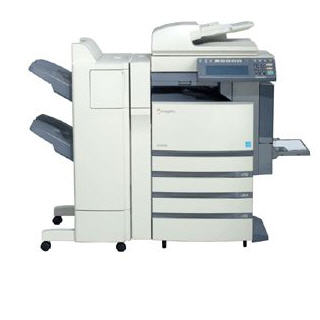
Normally, Office Copiers–the kind that have their own base with wheels on the floor–can be moved by regular movers. If there are no stairs involved, and the copiers are in the 200 to 400 lb range, they can either be pushed on their own wheels out of the office, or into the elevator, or they can be put on a 4-wheel dolly.

If there are stairs, it is a little trickier, but not that difficult. In that 200 to 400 lb range, they can be taken down stairs on an appliance-handtruck with a built-in cinching strap. There should be about 3 or 4 men to handle it.

If the copier’s collater or “finisher” is the kind that rolls away, then it should be detached, rolled away and taken down by itself. If the collater or “finisher” hangs off the copier, then the handtruck should be attached to the other side. The toner should also be removed if possible.

We took down two of these types of copiers down a steep staircase yesterday, and it wasn’t easy, but it wasn’t that much of problem. And the copiers came through fine.