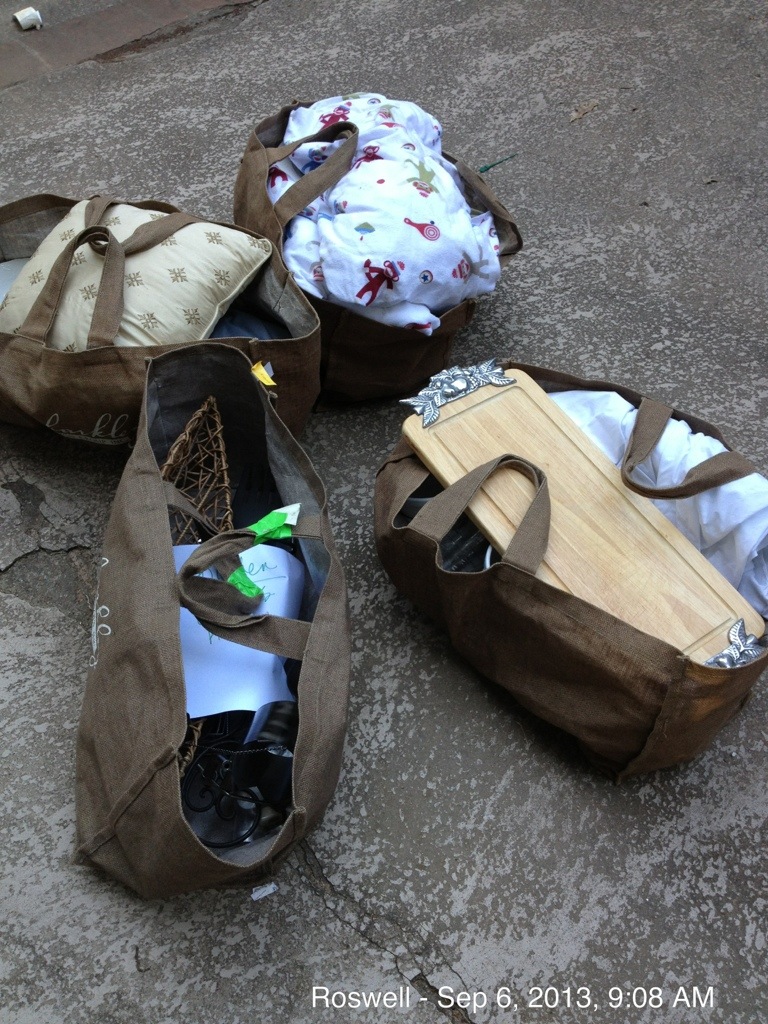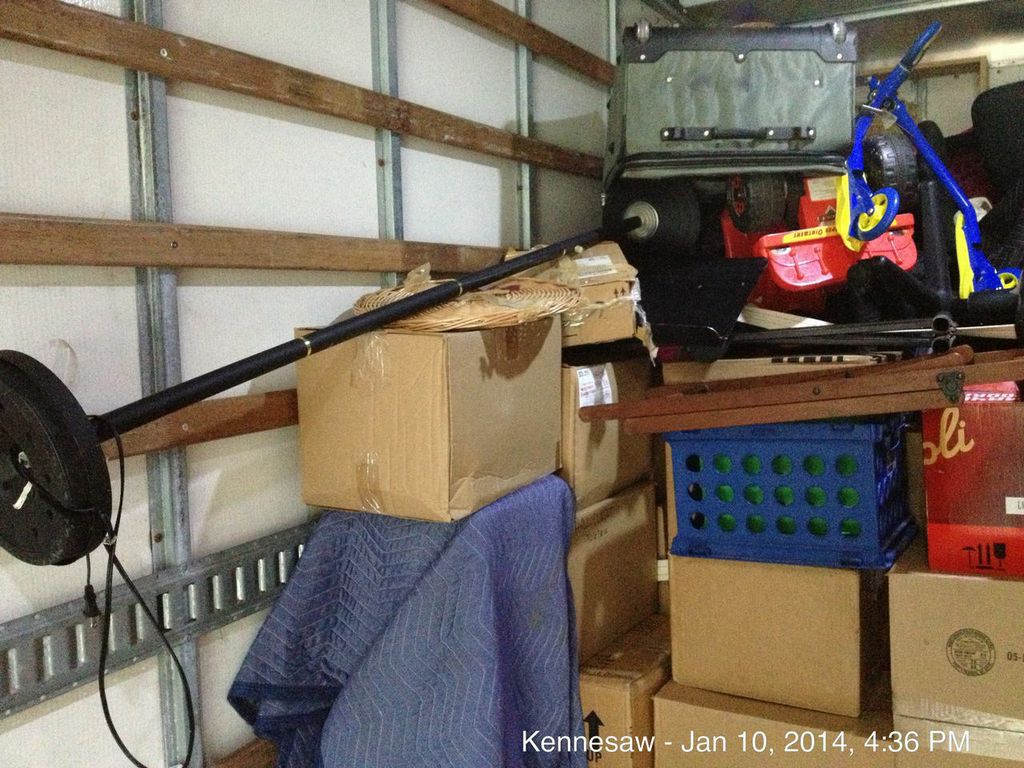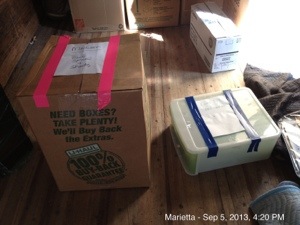
These small, light boxes should have been placed inside a larger box–like a “3.0 cube” box. The movers can much easier and faster handle one “3.0 cube” box than three or four tiny boxes. But list on the larger box the labels of the smaller boxes contained within.
Pack “Too Small” Boxes Within Larger Boxes
February 5, 2010 by Bob McGregorA Customer’s Chaotic Storage Bins
November 5, 2009 by Bob McGregor


These are pictures of a customer’s storage bins. The customer will remain nameless, but I can say they are a major medical practice! They directed our Moving Company to simply deposit these boxes and miscellaneous equipment in their bins. Some questions come to mind:
1) Are these boxes full of archived records that might need to be located at some time?
2) How do they expect to find anything?
3) Might there be a better way to organize these Storage Bins?
Moving a Washer Named “Herbert”
October 21, 2009 by Bob McGregor
This is a picture of employee, Detrick Scott, rolling a monster front-loading washer down the hall from the customer's unit in the mid-rise complex, “The Savoy” in Chamblee, GA. The customer actually named the washer "Herbert" and its matching dryer, "Eunice"–don't ask! But women love these things, and they say they get clothers cleaner than do the standard top-loading washers.
They're much more sensitive to moving than top-loading washers. With front-loading, you're supposed to be install special stabilizing brackets in the back of the machines. The machines are supposed to come with them when they're new, but guess what–they often don't. We haven't had a damage claim yet on these front-loaders, but it's a "knock-on-wood" situation.

Sometimes We Move Industrial Equipment
August 17, 2009 by Bob McGregor

These pictures were from moving a Shoe Repair shop. In the Moving World, there is a category of moving called “O & I” — Office and Industrial. This definitely qualified as “Industrial” Moving!
About Tipping Moving Workers
May 21, 2009 by Bob McGregorTipping moving workers is not mandatory like tipping restaurant workers. Restaurants workers make a special minimum wage close to $2 per hour, and the bulk of their income is from tips. Moving workers makes several times that, but still not that much. Tips are a very significant part of their income.

Most professional people have experience tipping wait staff, hairstylists, and bellhops, and beyond that their experience may be limited. Customers with a good amount of experience using professional movers—usually tip, but many customers are using professional movers for the first or second time and have not had to address this topic before.
The Cultural Norm in Atlanta in 2009 is that experienced customers will usually tip if they are pleased with the move. You don’t use percentages like with restaurants, but think in term of dollar amounts per member of the moving crew. For a several-hour or all-day move, $20 to $40 per man is a good tip. Not infrequently the tip is above that, but then that is a GREAT TIP! If it is only a half-day move, you would adjust the tip proportionately.
When I as the owner am a member of the moving crew, I don’t expect to get a tip, but when the Driver/Crew Chief is not the owner—don’t forget him! Customers will sometimes think the Driver/Crew Chief is not working, because he is not carrying in the heaviest furniture. He is on the truck, wrapping and putting items into tiers, and unloading items. He also drives the truck and supervises the whole operation, so if anything he should get a larger tip, but an equal tip is fine too (and the Driver/Crew Chief does not make that much more per hour than the workers)
Residential Moving is a personal service. The workers may not be bringing your food to the table or cutting your hair, but they are handling your personal household goods, which includes your furniture, boxes, and all other household items being moved. During an office move there is not that the same “personal feel”—a file cabinet is not as “personal” as say a vanity table. Accordingly, office moving workers get tipped much less frequently.
The reality is that moving workers try to “size up” a customer in the beginning of the move to determine whether or not they will tip and how well. Guess what? The workers work harder when they predict they will get a good tip.
Please give me your comments on what you think about this. There are definitely no “hard and fast rules”
Moving an American 1850 Antebellum Sofa
May 19, 2009 by Bob McGregor
We moved this sofa last week. The customer wouldn’t guess a dollar figure on how much it is worth–A LOT!! I’ve seen something like these in museums, and she said that actually 1850 American sofas are worth much more on the antique market than 1850 European sofas. Probably because there are fewer American sofas of this age.
This sofa is actually came from her ancestor four-or-so generations back, who lived on a Southern antebellum plantation. This customer had other expensive armoires and wardrobes from Europe, but she said this sofa was by far her most valuable piece.
She told me the details on this sofa almost in a whisper. She related later that she didn’t want to go into too much detail about the origins of the sofa in front of the African-American moving workers, whose ancestors theoretically COULD HAVE BEEN SLAVES ON HER ANCESTOR’S PLANTATION!
To protect the sofa for the move, we first taped clean quilted pads around it, and then shrink-wrapped it. With newer, more common sofas, you can stand them up on-end in the truck. But WE WOULDN’T DREAM OF DOING THAT WITH THIS SOFA! Besides the eagle-talon style feet had been cracked and repaired before. So the sofa had to stay right-side-up at all times and we put it right-side-up on its feet at the end of the load in the truck. We had to make sure we had extra space, since the sofa was on its feet taking up a lot of room, and nothing could be stacked on top of it!
Wrapping Pictures in Paper Pads
May 13, 2009 by Bob McGregor
The normal “deluxe” way of wrapping/packing pictures and paintings is to wrap it first in a paper pad, and then put it in a four-piece picture box. Putting together four-piece boxes is very time-consuming, but certainly recommended for very high-value pictures and fragile mirrors.
Often a good compromise is to wrap the picture/painting in just a paper pad. It’s easy and the paper pad is clean unlike a quilted pad which has probably been through the “ringer” many times, and may be full of dirt and mud.
Using a ladder helps the packer to pack tiers up to the ceiling
May 5, 2009 by Bob McGregor
Moving Items to Self-Storage Bins
May 3, 2009 by Bob McGregor
Ricky Packing a Storage Unit
We will move a customer’s items either to their own storage, or to our storage:
1) If they are using their own storage, we will tell them what size storage bin they need.
2) <a href=”“>Usually climate-controlled storage is not required, though we also offer climate-controlled storage if it is really required.
Carpet Mask
May 1, 2009 by Bob McGregor

Carpet Mask is a very effective way to protect carpets during an office move. We have an applicator where we can just roll the stuff down. It is a lot quicker to use than masonite.