Preparing for Your Move Item By Item – THE REFRIGERATOR

moving-refrigerator-drawing


1) NEEDS TO BE EMPTIED:   

A) Refrigerators are heavy enough even while empty

B) Messy things happen when full refrigerators are tilted during moving.  Items will melt and leak out.  One time, workers moved a refrigerator with Vanilla Ice Cream inside.  By the time, the refrigerator was being unloaded, the ice cream was melting.  The customer likes the smell of Vanilla Ice Cream, but not on her new rug.

C) If the truck breaks down and is idle for hours or days, then the items in the refrigerator will melt and leak throughout the truck—potentially contaminating the whole load.

EMPTY THE REFRIGERATOR

refrigerator-water-line


2)  The Water Line:  if the Refrigerator has an ice-maker, then it has a water line attached to it at the bottom of the refrigerator back.  The water line needs to be turned off.  If the house is relatively new, then you will probably be lucky and the turnoff valve may be right there at the wall.  If the house is older, then it could be Hunt and Seek for the turnoff valve—often down below the house hopefully in a basement, or worse—in a crawl space.  Follow the water line from the refrigerator and see where it goes.  It may just go under the sink, but it will probably go through the floor to whatever is below.  If it is a crawl space, then you may need a flashlight, your dirty clothes, and the will to climb through the dark and muck.  When you find the T-valve, turn it so it is crosswise to the water line.  This should turn it off, but IMPORTANT: also tighten the bolt immediately above!  Many have failed to do this and even with the T-valve turned—water has dripped into the house, and those drips add up!

For more technical information about refrigerators,  see the link under “Vendors’ in the column to the right to “The Fridge Doctor.”

A New Moving Hazard

garden-hose-on-spindle

I experienced a new “moving hazard” today, but it is something a California-and-Atlanta-boy–I was born in California and lived there until age 31, and have been living in Atlanta ever since– would run into.   The customer wanted us to move his garden hose.  No big deal–just as long as you make sure there is no water leaking!  The hose was on a spindle and I turned it this way and that.  I shook it up and down;  I shook it sideways–no water leaking!  I left it on the ground so I could look it for awhile–no water leaking!  So I put it in the load, on top of a fully padded armoire.

Three hours later, while doing the unloading at the destination, I NOTICE WATER LEAKING OUT OF THE HOSE!  What gives?!  Where did the water come from?  Then I remembered that it was 18 degrees when we started the job this morning, and now its 39 degrees.  This morning there was no water leaking out of the hose, because it was FROZEN!  Only someone who only does a few moving jobs per year in freezing temperatures, would make that blunder.  I still kept the hose away from any mattresses or upholstery,  so only a relatively small amount of water dribbled down the pads.

The “Hard” and “Soft Factors” of a Move

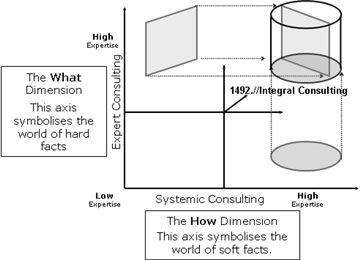
After I survey your client’s home, or office to be moved, I Design a Move for them based on what I call the “Hard Factors” and the “Soft Factors.” Hard Factors are quantitative and involve the inanimate realities such as the furniture, boxes, crates and access issues at the origin and destination.

From these raw variables I determine the number of total man-hours required, and what will be the best mix of trucks and Moving Equipment. The “Soft Factors” are human factors: I have general questions such as: What is the customer like? Emotional Type “A” or Type“B”? How did they find out about us? What is their experience with Movers? What are their expectations from the Movers? And then more specifically: Is the scheduled move contingent on a Closing or Closings? Are they more worried about their money, their furniture, their time, having to do tedious physical work themselves, or something else?

Based on the hard and soft factors for your client’s specific case, I design the most efficient and ultimately satisfying move for them.

“For My Residential Move, Can I leave the drawers full ?”

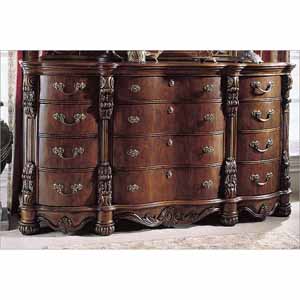
The short answer is it is best to empty the “large” pieces like dressers, chest of drawers, armoires, wardrobes, buffets, china cabinets, and desks.

The items that have to be moved have to be moved some way by someone. The question is what is the most efficient and cost-effective way. There are large bedroom pieces which physically cannot tolerate being moved full. “High-boys,” for example are in danger of having their legs snapped if moved full. Others can only be moved full with the assistance of special equipment like a refrigerator hand-truck. Often this is fine if it is a ranch house with old carpet floors. But in a multi-level house with hardwood floors—now you have to worry about damaging the floors.

Many Movers will say as a marketing ploy to “just leave everything full,” but when they need to, they will take the drawers out anyway.

For the drawers you do leave full, remember to go through them and check for valuables like currency, watches, jewelry, and firearms. You would be amazed how many people do not do this even after being reminded to. Many people have more loose valuable items like these than they can keep track of, and simply forget they are being kept in back of a drawer.

One time we were carrying a dresser down the stairs; a drawer opened up; a pistol fell out and to the ground and went off !!! Fortunately it was just a “starter pistol,” but we didn’t know that when we heard the gun fire.

Since the Movers may remove drawers and move them separately, think about the contents of the drawers and whether you want them being waved in the breeze. You probably won’t mind if the contents are pants and sweaters, but how about underwear and other bedroom items? Discrete, professional Movers will concentrate on their task at hand, and have seen everything anyway, but it is something to keep in mind.

In another situation, a long dresser may be not be all that heavy, but in order to get out of the bedroom it has to be stood up on end. When this happens, if the drawers are full–many loose items will be thrown against the side of the drawers (now pointing down), and the structure of the dresser will be tested. A quality dresser will hold together, but a press-board dresser may fall apart right then.

The conclusion: empty the drawers of the large pieces. The move will go faster if all the drawers are empty, but then that means extra work box-packing—whoever does it. A good compromise is to just leave “full” the “medium” and “small” pieces.

Moving to High-Rises Like “Plaza Towers”

We will be moving a repeat customer next week to the 20th floor of the “Plaza Towers” on Peachtree Road.  This building is incidentally across the street from the “Park Place” high-rise which is where Elton John is reputed to have a penthouse (see picture below)

Our customer is only moving a one-bedroom apartment, so she initially felt a two-man moving crew would suffice. I explained that High-Rise moves add an extra layer of complexity and risk.

If you just have a two-man crew, then there is not an extra man to watch the furniture in the truck or left outside the elevator. Once we had a dresser stolen that was left outside an elevator of an upper floor of another High-Rise in town. During an unload to a High-Rise: With a three-man crew, one man can push items from the truck to the elevator. The other two men can take the items up the elevator into the destination unit.

A FEW THINGS TO REMEMBER ABOUT HIGH-RISE MOVES:

1) Talk to the Building Management about the details of reserving the freight elevator.

2) Will the Movers have exclusive use of the elevator during that time period? If they don’t, the move will take much longer.

3) Will the Movers have a key to the elevator, or will it otherwise be “locked” for them, or will they have to wrestle with trying to hold the door open as they move items in and out of the elevator?

4) A High-Rise residential move is similar to an Office Move in that additional four-wheel dollies are required. Make sure the Movers have between 10 and 20 four-wheel dollies on the move. The more furniture which can be loaded onto dollies, and rolled into and out of the truck, and then into and out of the elevator and into the destination unit, the faster the move will be.

Make Sure the Movers Have Between 10 and 20 of These

Make Sure the Movers Have Between 10 and 20 of These

The Physical Strain of Packing and Moving Boxes


I bet these boxes are empty!

I bet these boxes are empty!

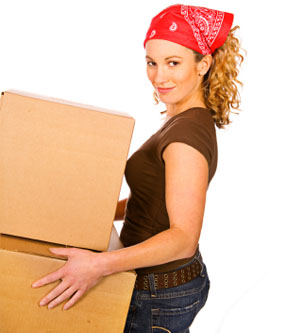
WHAT AN UNREALISTIC ADVERTISING SHOT.   If these boxes were full, she would have to be holding them from the bottom, and this girl could probably not carry both at once!


Yesterday I booked a job for a couple about 65 years old who are moving close-by.  They want to move all the boxes themselves.
I reminded them of the physical strain involved in packing and in moving boxes:
First you have to get the items off the shelf.  You have to get down on your hands and knees for the low shelves, and on a stool for the high shelves.
Once they are wrapped, you need to place them in the box.
Once the box is packed and closed up, you have to get it out of the way.  You have to carry it somewhere and probably stack it on top of other boxes, bending down or stretching up to do it.
Then you have to get the stack of boxes to your car–either carrying each box or rolling the stack on a handtruck if you have one.
Then you have to place it in the car, and even with SUV’s some bending over is required.  Remember box-packers cost less than the orthopedic surgeon.

Box-Packing Primer

USE THESE BOXES

"Large or Linen Box" (4.5 cubic ft.)

"Large or Linen Box" (4.5 cubic ft.)

"Book Box" (1.5 cubic ft.)

"Book Box" (1.5 cubic ft.)

"Medium Box" (3.0 cubic ft.)

"Medium Box" (3.0 cubic ft.)

"Extra Large Box" (6.0 cubic ft.)

"Extra Large Box" (6.0 cubic ft.)

"Dish Pack Box" (5.1 cubic ft.)
"Picture Box"

"Picture Box"

“Dish Pack Box” (5.1 cubic ft.)
"Wardrobe Box"

"Wardrobe Box"

NOT THESE BOXES

You may think it is worthwhile to pick up old grocery or liquor store boxes, but it’s not. Grocery boxes are designed for seperating food in the truck and warehouse. Moving boxes are much heavier-duty and designed for protection of your home items and for ease of handling by you and the Movers.

If you are box-packing a whole house properly, you will most likely use all of the seven moving box types above, plus the paper pads. Like there are many different kitchen tools, each box is sized and designed for a specific purpose.

“Book Box:” (1.5 cubic feet): Heavier items, but not fragile kitchen items.

  • Living Room: Books, CDs, Albums (if you have those old things), small lamp shades
  • Office: Files, heavier items, small lamp shades
  • Kitchen: Bottles and cans

“Medium Box” (3.0 cubic feet):

  • Living Room: Stereo and TV components
  • Kitchen: Small Appliances: Coffee Maker, Cuisinart, Electric Can Opener
  • Bath: Toiletries in cabinet under sink and in shower, medium lamp shades
  • Office: Electronic components
  • Bedroom: Child’s small toys, games, medium lamp shades

“Large or Linen Box” (4.5 cubic feet):

  • Living Room: Very large lamp shades
  • Bath: Towels
  • Bedroom: Linens, Sheets, Folded Clothes, Shoes
  • Dining Room: Table Clothes and Soft Items from Buffet

“Extra Large” (6.0 cubic feet): Certain boxy-shaped items are too tall for the 4.5 cubic foot box, but not fragile items meant for the Dishpack box (Big computer monitors, other large fragile items that need to be boxed)

Picture Box:” They come in one piece, 2 piece, and 4-piece sizes. The 4 piece sizes are more flexible and expandable. Used for expensive fragile mirrors and paintings and pictures. Usually you will want to wrap the mirror or picture with a paper pad before inserting it into the picture box.(Just use one picture per box)

Tape Along the Open Seams to Strengthen the Box

Tape Along the Open Seams to Strengthen the Box

“Dish Pack Box” (5.1 cubic feet) (its walls are double-thick):

  • Kitchen: Pots and Pans, Fragile Dishes and Glass Items (pack the heavier items on the bottom, and pack successively lighter but fragile items as you go higher in the box). Pack dishes and china on their EDGE, NOT FLAT IN THE BOX! This is a very common error. And use plenty of newsprint, and use bubble wrap for extra-fragile pieces.
  • Living Room: Vases, Fragile Knick Knacks; Fragile lamp bases (make sure the top of the lamps bases (name?) are not jammed in there. They bend and are easily damaged. If the lamps are too tall for the dishpack box, use a a taller box—even a wardrobe box if that’s the next taller size you have.

“Wardrobe” (14.0 cubic feet): Hanging clothes, items too tall for any other box—tall lamps
“Mirror/Picture Boxes” (approx. 3.0 cubic feet):

“Bass Lofts” in “Little Five Points”

Grooving with the Frieks in Little Five Points

Grooving with the Frieks in Little Five Points

We moved a customer into the ”
Bass Lofts
” today on Euclid Ave. It is the old “William Bass Junior High School” which was built in the 1920s. Our customer had us go in from the south side of the building. There is a parking lot with a “Circle” at the end. A sign says “No Parking in the Circle,” but there were about seven cars parked there.  With the cars parked there, you can still drive a car around the circle, but not the Moving Truck.

We made an awkward turn-around and were able to get the truck in a decent place without tearing down too many branches. There was still about a 125 foot walk to the stairs (four stone steps) going up to the double-doors going into the building. This was a small one-bedroom move, and we completed it in two hours, but only because we had three men, and plenty four-wheel dollies and a speed-pack. A speed-pack is a very large box you can put on a four-wheel dolly and load up with small items like chairs and lamps and loose items. You can then roll all those items down the long hallways and into the elevator.

Our customer was pleased and gave us each a tip.  It was neat to see the old building, and the displays with school pictures from the 20s, 30s, and 40s.

Four-Wheel Dolly,
Four-Wheel Dolly, “Chicago” Style

“So Your Friends or Family Members Are Going to Help You Move?”

1) Who is going to drive the rental truck? What kind of vehicle do they normally drive? Do they have experience driving a big moving truck? If they crash it, who is going to be responsible?

2) Who is going to carry the furniture to the truck? Do they carry a lot of heavy furniture in their spare time? What if they get hurt? Is your client going to pay their medical bills?

3) What if your client’s friends don’t even show up to help him? Which do you think they would rather do—enjoy their Saturday morning off, or help your client move heavy furniture for free? And as for him getting his friends to do this – does he also ask his friends to come over on Saturday morning and change his car’s transmission?

Your clients will be better off with a quality professional mover.

“Hard Factors” and “Soft Factors”

After I survey your client’s home, or office to be moved, I Design a Move for them based on what I call the “Hard Factors” and the “Soft Factors.”  Hard Factors are quantitative and involve the inanimate realities such as the furniture, boxes, crates and  access issues at the origin and destination.  From these raw variables I determine the number of total man-hours required, and what will be the best mix of trucks and Moving Equipment.

The “Soft Factors” are human factors: I have general questions such as: What is the customer like? Emotional Type “A” or Type“B”?  How did they find out about us?  What is their experience with Movers?  What are their expectations from the Movers?  And then more specifically: Is the scheduled move contingent on a Closing or Closings?  Are they more worried about money, furniture, time, doing tedious physical work themselves, or something else?  Based on the hard and soft factors for your client’s specific case, I design the most efficient and ultimately satisfying move for them.