Moving in the Snow

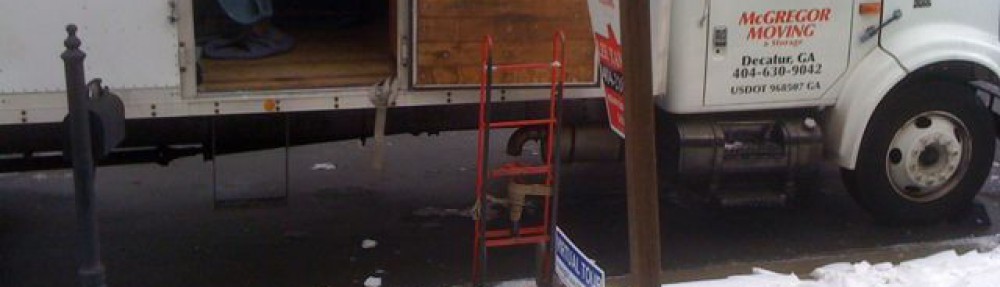
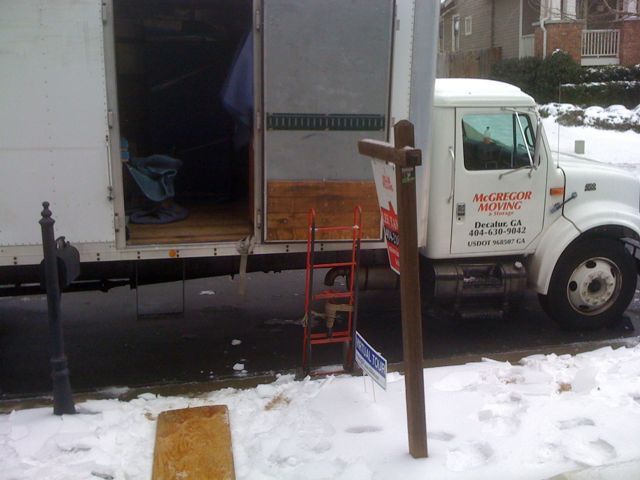
In Atlanta we don’t usually have to do moves in the snow. But last month was an exception. On a day when all the schools were closed, and most of the city was shutdown, we were able to get this house loaded even with snow and ice on the ground.

The customer sprinkled salt on the front porch, and we had a strip of plywood to lay over the snow–see below. As long as we loaded most of the items through the side-door, and not through the rear door where we had to use the ramp, then we were okay.

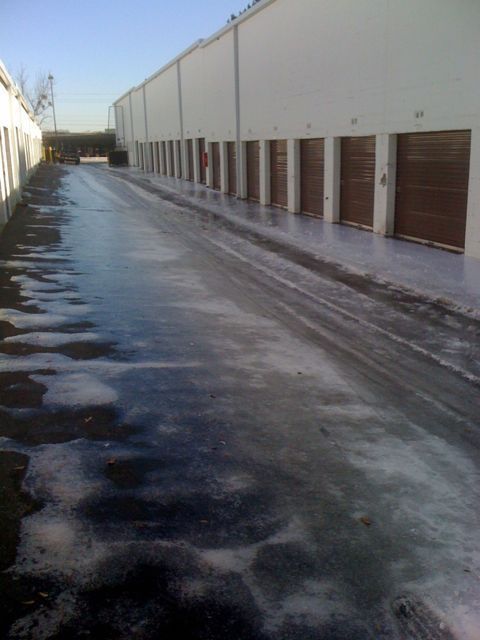
But though the load was successful, we weren’t able to unload at Storage–see picture. The ice made the storage roadway impassable. We had to leave the items on the truck for a few days, and wait for the “big melt.”

Common Mistakes in Downsizing: Acting as if the downsizing is very temporary.

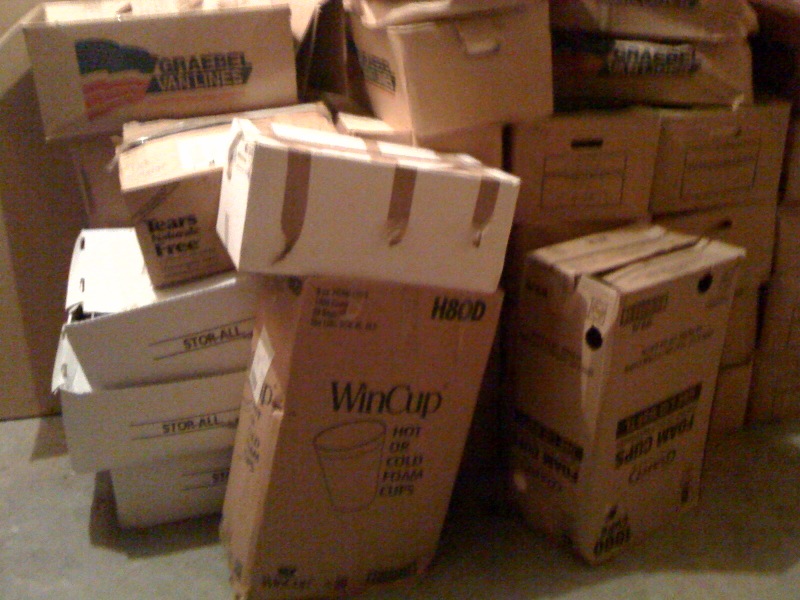
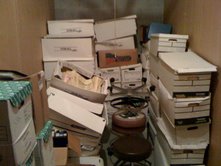
Not Recommended Way of Stacking Your Boxes in Storage Bin


Healthy optimism may dictate you or your client see the downsizing as very temporary.   But this becomes very costly if this means putting a lot in storage for when you return to living in a big house or office.  You or your client may have a financial recovery, but it is rarely worth it to pay monthly storage until that happens.  A 10×20 storage unit is around $170 per month.  That is $2040 per year.  The average storage bin customer has their stuff in storage for 22 months.  At $170 per month that means the average storage customer is paying $3740.  That is why mini storage is quite profitable.
Most of the time, the items stored are not worth $3740.  And guess what?  If they are, then that means you could sell them and pocket hundreds or thousands instead of paying thousands.
It is better for your downsizing client to sell or give away the excess items when downsizing, and use the proceeds and storage savings to buy appropriate furniture and items when she does recover financially.

Mice and Rats in Non Climate-Controlled Storage

For a customer, this weekend we loaded from their non-climate controlled storage unit to their rental truck.  Their household goods had been in the storage unit FOR SIX YEARS !!!
Even though there was no sign of water in the storage unit, and no food—there were many RAT OR MICE DROPPINGS ON THE FLOOR THROUGOUT THE UNIT!  Furthermore, a leather sofa—which for some reason another Moving Mompany had left in the storage unit unpadded—HAD BEEN CHEWED BY THE RATS OR MICE!  There were only very small holes in the walls.  It would seem like mice could not fit through those holes, but they obviously did.
This seems to “give the lie” to my previous argument that non-climate controlled storage is plenty safe, but it’s definitely a matter of how long the items are left in storage!
“Ranking of Items Based on Increasingly Vulnerability to Non-Climate Controlled Storage”

1) Metal Desks, File Cabinets, File Cabinets: Would probably fare pretty well in a nuclear attack as long as simply hit by the radiation and not the fireball or shock wave.  Rats will not eat them, and air moisture will not be absorbed into them.
2) Wood Furniture: Expands and Contracts with changing temperature, and a certain amount of moisture flows through without damage.  Should not be shrink-wrapped while in storage, because when water does get on the furniture, the shrink-wrap will hold it there!
3) Upholstery: The “Archilles Tendon” of non-climate controlled stored furniture.  It is sensitive to moisture, and rats and mice like to chew on them.  Should not be shrink-wrapped while in storage.  Should be Quilt-Padded!

Moving A Customer Into Decatur, Georgia’s “Ice House Lofts”

CLICK TO GO TO SLIDE SHOW

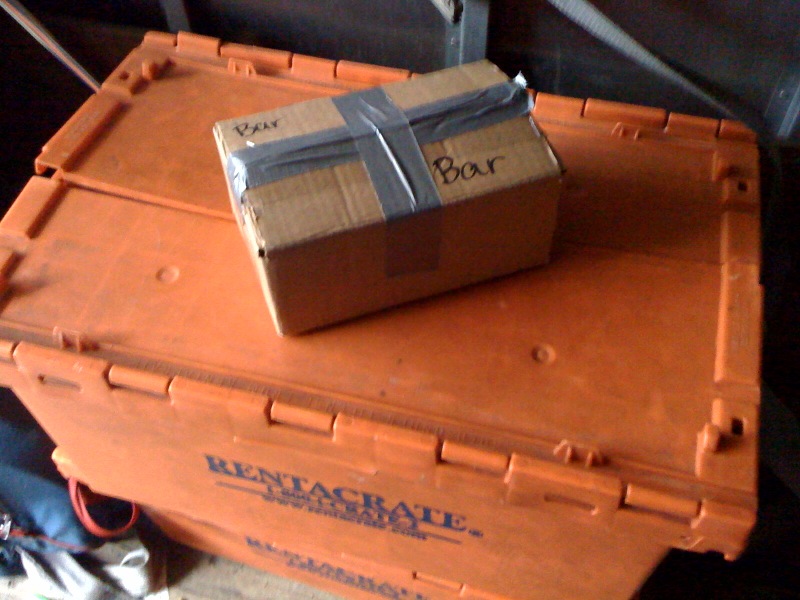
Pack “Too Small” Boxes Within Larger Boxes

These Boxes Should Be Packed Inside a Larger Box

"Same Here"

These small, light boxes should have been placed inside a larger box–like a “3.0 cube” box.  The movers can much easier and faster handle one “3.0 cube” box than three or four tiny boxes.  But list on the larger box the labels of the smaller boxes contained within.

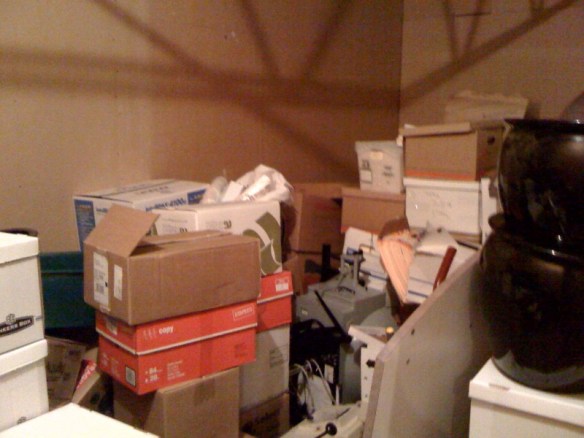
A Customer’s Chaotic Storage Bins

GEP Pic 1GEP Pic 2GEP Pic 3GEP Pic 4

These are pictures of a customer’s storage bins. The customer will remain nameless, but I can say they are a major medical practice! They directed our Moving Company to simply deposit these boxes and miscellaneous equipment in their bins. Some questions come to mind:

1) Are these boxes full of archived records that might need to be located at some time?
2) How do they expect to find anything?
3) Might there be a better way to organize these Storage Bins?

Moving a Washer Named “Herbert”

Detrick moving front-loading washer
This is a picture of employee, Detrick Scott, rolling a monster front-loading washer down the hall from the customer's unit in the mid-rise complex, “The Savoy” in Chamblee, GA. The customer actually named the washer "Herbert" and its matching dryer, "Eunice"–don't ask! But women love these things, and they say they get clothers cleaner than do the standard top-loading washers.

They're much more sensitive to moving than top-loading washers. With front-loading, you're supposed to be install special stabilizing brackets in the back of the machines. The machines are supposed to come with them when they're new, but guess what–they often don't. We haven't had a damage claim yet on these front-loaders, but it's a "knock-on-wood" situation.

About Tipping Moving Workers

Tipping moving workers is not mandatory like tipping restaurant workers. Restaurants workers make a special minimum wage close to $2 per hour, and the bulk of their income is from tips. Moving workers makes several times that, but still not that much. Tips are a very significant part of their income.

Most professional people have experience tipping wait staff, hairstylists, and bellhops, and beyond that their experience may be limited. Customers with a good amount of experience using professional movers—usually tip, but many customers are using professional movers for the first or second time and have not had to address this topic before.

The Cultural Norm in Atlanta in 2009 is that experienced customers will usually tip if they are pleased with the move. You don’t use percentages like with restaurants, but think in term of dollar amounts per member of the moving crew. For a several-hour or all-day move, $20 to $40 per man is a good tip. Not infrequently the tip is above that, but then that is a GREAT TIP! If it is only a half-day move, you would adjust the tip proportionately.

When I as the owner am a member of the moving crew, I don’t expect to get a tip, but when the Driver/Crew Chief is not the owner—don’t forget him! Customers will sometimes think the Driver/Crew Chief is not working, because he is not carrying in the heaviest furniture. He is on the truck, wrapping and putting items into tiers, and unloading items. He also drives the truck and supervises the whole operation, so if anything he should get a larger tip, but an equal tip is fine too (and the Driver/Crew Chief does not make that much more per hour than the workers)

Residential Moving is a personal service. The workers may not be bringing your food to the table or cutting your hair, but they are handling your personal household goods, which includes your furniture, boxes, and all other household items being moved. During an office move there is not that the same “personal feel”—a file cabinet is not as “personal” as say a vanity table. Accordingly, office moving workers get tipped much less frequently.

The reality is that moving workers try to “size up” a customer in the beginning of the move to determine whether or not they will tip and how well. Guess what? The workers work harder when they predict they will get a good tip.

Please give me your comments on what you think about this. There are definitely no “hard and fast rules”