Wrapping Pictures in Paper Pads

paper pads

The normal “deluxe” way of wrapping/packing pictures and paintings is to wrap it first in a paper pad, and then put it in a four-piece picture box. Putting together four-piece boxes is very time-consuming, but certainly recommended for very high-value pictures and fragile mirrors.

Often a good compromise is to wrap the picture/painting in just a paper pad. It’s easy and the paper pad is clean unlike a quilted pad which has probably been through the “ringer” many times, and may be full of dirt and mud.

Moving Items to Self-Storage Bins

Ricky Packing a Storage Unit

Ricky Packing a Storage Unit

We will move a customer’s items either to their own storage, or to our storage:

1) If they are using their own storage, we will tell them what size storage bin they need.
2) <a href=”“>Usually climate-controlled storage is not required, though we also offer climate-controlled storage if it is really required.

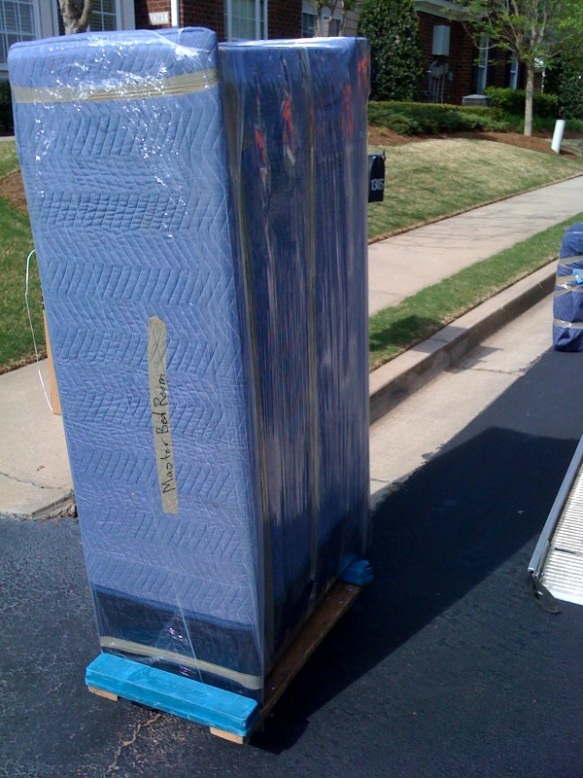
Dresser Wrapped Up and Ready for Loading From House in Roswell, GA

dresser-wrapped-up-ready-for-loading-in-roswell

I like the label on the dresser, “Master Bed Room.” Wrapping up the dresser in pads and shrink wrap protects it very well, but then you cannot identify the piece without taking off the pads and shrink wrap. The label tells the workers which room to push the dresser into.

Preparing Lamps For the Movers to Move Them

desk-and-pole-lamps

Lamp shades cannot go into the moving truck by themselves. They need to be packed in boxes–one lamp shade per box. You can surround the lamp shade with packing paper. Use the smallest box possible for the lamp shade. You will probably use either a 1.5 cube, 3.0 cube, or 4.5 cube box.

If the base of the lamp is not fragile–if it’s brass or some hard material, then the Movers can just wrap the lamp base in a pad and place it in the truck. If the lamp has a vase-like base, then it needs to be placed in a box.

Movers can take pole-lamps into the truck, as long as the lamp shade is removed.

Preparing Paintings and Pictures To Be Moved

Glass Covered Painting, and small enough to go in Dish-Pack Box

Glass Covered Painting, and small enough to go in Dish-Pack Box


Dish-Pack Box in which small paintings and pictures can be packed

Dish-Pack Box in which small paintings and pictures can be packed

For moving purposes, there are four categories of paintings and pictures:

1) Ones small enough to fit in a Dish-Pack Box:

Since a Dish-Pack dimensions are around 24” x 20” x “34, the picture should be small enough to comfortably fit in the box. Wrap the pictures in Packing Paper or even Bubble-Wrap—though Bubble-Wrap is usually not necessary—and you can fit multiple pictures this size in Dish-Pack Box

2) Paintings or Pictures too large to fit in a Dish-Pack box, and under $1000 in value which are covered with glass:

Because of its glass-covering, the painting/picture might be moved safely covered in either a quilted pad or a paper pad—as long as the picture frame is not fragile or expensive. If it is, then we should use the next higher level of protection—the Picture Box. The best way is to wrap the picture in a Paper Pad before inserting it into the Picture Box. If you don’t have a Paper Pad, you can also use Packing Paper or Bubble-Wrap. Make sure you protect the corners.

Framed Oil Painting--Needs be covered in Paper Pad, then placed in Picture Box

Framed Oil Painting--Needs be covered in Paper Pad, then placed in Picture Box

Picture Box

Picture Box

3) Paintings or Pictures too large to fit in a Dish-Pack Box, and under $1000 in value which are not covered by glass—“Oil Paintings:”

You don’t want a dirty quilted pad to touch the surface of an oil painting, and they usually have decent frames so a Picture Box is usually required. The best way is to wrap the picture in a Paper Pad before inserting it into the Picture Box. If you don’t have a Paper Pad, you can also use Packing Paper or Bubble-Wrap. Make sure you protect the corners.

Pictures Wrapped in Paper Pads Without "Picture Boxes" Surrounding Them

4) Paintings/Pictures over $1000 in value:

$1000 is obviously an arbitrary even number, and the number should climb higher with inflation, but in 2009 most Movers will think about having a wooden crate made for pictures in this value category. And there are many pictures in Atlanta homes valued at 10K, 50K and higher. Movers are not going to put a high-value picture in the truck without it being in a wooden picture crate. If it’s a local move, the homeowner/customer does have the option to move the picture himself–in his car–in order to save the extra cost of having the wooden crate made. Check to make sure your vehicle will accommodate the size of the picture.

Getting a Quote From a Mover

happy-family-laying-on-boxes

The Homeowner/Tenant’s Own “Ballpark Estimate”

Even before the homeowner or tenant talks to the Mover, he or she will try will probably in their own mind try to come up with a ballpark figure on how much it might cost. $300, $500, $1000, $2000, $10,000, what is it? The Homeowner or tenant can start by comparing the
upcoming move to the last one. Here are some simple steps to do that:

i) Do you have the invoice or Bill of Lading which shows how much you paid for the last move? Does it show how many hours were billed and how many men were on the crew, or was it a flat rate?

ii) How long ago was your last move? The average person moves once every five years. If it was five years ago, it is unlikely you can accurately remember details like how many hours it took and how many men were on the crew.

iii) How is the load different this time? Usually expressed as what additional things do you have now that you did not have the last time? The load also might be different in that you or your friends or family moved some of the stuff last time. Five months ago we moved a young attorney from Grant Park to Virginia Highlands (both in the Atlanta area). Then she herself took over boxes to the new place the whole week before the three-man moving crew showed up to move the furniture. Two weeks ago we moved her again. When she was considering a ballpark estimate for this move, the 4.75 hours it took the crew last time was—impressed on her mind. But this time the crew would be moving all the boxes and up to a third-floor apartment. The previous move it was ground floor to ground floor. The result is this move took 7.50 hours instead of 4.75.

1) Getting an Estimate From The Mover

A) On phone
B) Via Email
C) Through physical on-site survey

An Estimate Over The Phone:

Needs be fairly detailed:

a) What is the Access like at the Origin
b) What kind of dwelling is the Origin? Apartment First Floor? Three-Level House? Storage-Unit?
c) What needs to be moved? List all the furniture you can think of. If you’re talking on a cell phone or cordless phone, it helps if you can walk from room to room describing all the furniture as you go.
d) Estimate the number of boxes
e) What needs to be disassembled?
f) What is the Transit like (from Origin to Destination) in miles, time to drive in a car—a moving truck will be slower—will there be traffic?
g) What is the Access like at the Destination
h) What kind of dwelling is at the Destination
i) What needs to be reassembled? Usually it is the same as the items disassembled, but not always. For instance, beds and tables taken apart at the Origin, may just be stored in the basement at the destination.

Via Email

Email takes more work on the part of the homeowner/tenant. She has to type the list rather than just speak it, but writing it tends to make it more accurate. And there is no dispute what was spoken—there’s the list in black and white. An email inventory list from the homeowner can then be followed by an email reply quote by the Mover. So an email channel is opened, and this can be very helpful to both sides. Many of our best customers are corporate types for who it is often easier to email than to phone. They might feel more comfortable asking small, piddly questions through email than over the phone—questions like, “Can they leave the clothes in the drawers?” If I am the Mover, then in my reply email I can easily link to my Blog posting that talks about that very thing.

Estimate By On-Site Survey

By far the best way to do an estimate.

A survey is where you go out in person and list all the inventory items and assess the size of the move.

If I’m the Mover, I’ll walk through the prospect’s house with this sheet called a “Cube Sheet.” It is a list of all the major furniture items types and their average cubic feet. If an item is not on the list—say it’s a big entertainment center—I can measure it. In inches you multiply the height by the width by the depth and then divide that by 1728 and you get the cubic feet.

You add up all the cubic feet for all the furniture items and boxes and you get the total cubic feet. The average cubic foot of household goods weighs 7 lbs so you multiply the cubic feet by 7 to get pounds. If there are 1500 cubic feet of household goods, then they weigh about 10,500 lbs. Many Movers, including this one, will often quote a flat rate for the move just based on the pounds. Movers have this term called “hundred-weight.” “Hundred Weight” is the total poundage divided by 100. If you have 10,500 lbs. Divide that by 100 and you have 105. That becomes the hundred weight. Now you can multiply it by a hundred weight factor. So a mover might charge a rate of 13.5. 105 * 13.5 = $1417.50. This is coming up with a price by just going from lbs of furniture to flat price for the move. You’re not concerned with the particulars of how many trucks and men you will need to do the move. To figure that out you apply the next number which is “the number of lbs each man will be able to move per hour. This number will fluctuate, and a lot of the “quote” expertise in doing a moving estimate comes in choosing this number. It’s almost always between 400 and 750 lbs per man per hour. If you have a really sharp three-man crew doing a cookie-cutter move of a 2-bedroom apartment, ground floor to ground floor, then they can move at the top rate—750 lbs per man per hour.

Personally, I really like doing surveys and quotes. For me, going from a move survey to a move quote is the single neatest application of numbers to solving a problem that I’ve ever experienced. When I say “neatest,” what I mean is here you have a ton of stuff to be moved—several tons probably. You apply some numbers, ratios, and simple formulas and “WaLa,” here’s your plan and the cost for the move. It’s a little engineering project.

Access Issues on a Residential Move

The size, complexity, time length, and cost of a move can be broken down into the following three variables:

1) The Load
2) Access Issues
A) Access at the Origin
B) Access at the Destination
3) The Transit (from Origin to Destination)

In this posting we will discuss the second variable, “Access Issues.” How easy is it to get to the furniture at the Origin and how easy is it to deliver it at the Destination?

So for any move, there are access issues to contend with at both the Origin location and the Destination location. For both the Origin and Destination, the estimator needs to look at:

moving-truck-parked-11

1) Truck Parking

A) Will the truck park on the street or in the driveway?

steep-driveway-1

B) If on the driveway, is it flat, circular, declined, inclined, or too steep for the truck?
C) If on the street, is it a small side street or a busy boulevard? Just try parking on Clairmont Rd. (busy street in Atlanta). Moving trucks get $150 parking tickets when they park on busy streets in downtown Atlanta to do high-rise moves.

D) Is there a Loading Dock? If so, then the items will come out of the truck quickly, but there is probably a long walk to the residential unit and there are probably elevators involved. The movers will need 12 to 30 of the 4-wheel dollies in order to efficiently roll the items being moved.

E) Is there a parking structure? If so, the truck is most likely too tall for the entrance and will have to park outside the parking structure. There will most likely be a long walk to the elevator, and again, the mover will need 12 to 30 of the 4-wheel dollies.


big-canoe-2 big-canoe-3 big-canoe-4

F) In extreme cases, the roads themselves leading up to the house may be impassable by the Moving truck. There are mountain towns like “Big Canoe” in Georgia where many of the town’s roads are impassable by tractor trailers. In Big Canoe, there are places where even standard 24’ box-trucks need to be in either 2nd gear—if a standard transmission—or the lowest gear if an automatic transmission. Once you get to the mailbox, there may be a steep winding driveway which now requires a still smaller vehicle—like a 14’ shuttle truck or even a van—the size of an electrician’s van.

2) The Walk From the Truck to the House

A) How many feet, or how many car-lengths—of a standard-size sedan like a Camry?
B) Is the walk level, up, or down?
C) Over what type of terrain? If asphalt or concrete, then four-wheel dollies and handtrucks can roll smoothly over it. But if the walk is through a yard, If it is through grass, or dirt, or gravel then rolling a four-wheel dolly or handtruck may be impossible.

3) Are there Stairs or an Elevator?

A) If stairs? What kind, and how many? Up or down?
i) Stairs can be hardwood, in which case you cannot set heavy furniture like armoires on the stairs or else they will scratch
ii) Stairs can have new white carpets which will streak if handtrucks are rolled on them
iii) Stairs can be narrow and have switch-back turns which are difficult to navigate with large furniture like sofas and armoires.
iv) Staircases may have low overheads, especially in low townhouses, where a Queen-sized box spring will not fit up the stairs.

B) If there is an elevator, what are its limitations?
i) Is it a freight elevator which you can reserve and dedicate for your move?

ii) What are the allowable hours for using it during a move? (For Office Moves in Class A buildings, you usually have to move after 5:00pm or 6:00pm during the week or during the weekend) Residential moves can have time restrictions too. We did a move recently into the “Campbell Stone” retirement building in Sandy Springs, GA, and they do not allow moves to be occurring between 11:30am and 1:30pm

4) Going into the House, Condo, Loft, or Apartment

A) Front Door: Double or Single-Door? Narrow or Wide Door? “Straight-Shot” in or is there a tight right-angle turn to get in the door. Once you get inside the door, is the staircase in the way?
B) What is the Floor Like Going in the Door?
i) Real hardwood? Light or Dark? Light shows the scratches more and is more difficult to touch-up or repair?
ii) laminate? Less sensitive, and easier to repair, but dents more easily.
iii) Carpet? Light or Dark? How new? How easily does it tear?
C) Doorways Inside: Are they narrow? Will the refrigerator’s door need to be taken off in order to get through the doorway, or will the refrigerator have to be put on a four-wheel dolly, and then one-door opened and maneuvered through the doorway with the door open?
D) How Many Levels? One level, two, three, or four?
E) How many rooms are there? and how big is the house (how many square feet?) The size of the house will greatly effect the amount of time it takes to do a move, and this is independent of the total pounds on the load. For a load of 7200 lbs of household goods, a crew may be able to move it at a rate of 700 lbs per man per hour when it comes out of a first floor, two-bedroom apartment. When the same load comes out of a 6 bedroom, 8000 square foot house, the crew may only be able to move it at a rate of 425 lbs per man per hour!
STORAGE — “Climate-Control” or “Non Climate-Control?”


Climate-Controlled Storage Building

Climate-Controlled Storage Building


           Versus        

Non-Climate-Controlled Storage with External Door

Non-Climate-Controlled Storage with External Door


With apologies to “Public Storage” and other climate-control storage companies—“Climate-Control Storage” is mostly a marketing gimmick and a very Non-Green one at that (think of how much energy they are using cooling and heating all those storage units.  It is a shame to spend all that energy cooling inanimate objects.  The furniture is not going to complain about the heat—I assure you.)  The fact is: in the far majority of cases, non-climate controlled storage works just fine.  You may have heard of furniture sustaining damage in non-climate controlled storage, and that is invariably because WATER GOT INTO THE STORAGE UNIT!  Especially when water got into the unit, and then SHRINK WRAP HELD THE WATER IN PLACE.  This creates mildew and over time it is damaging to both upholstery and wood furniture.  IF IT IS RAINING ON THE DAY FURNITURE IS PUT INTO STORAGE, THEN NO SHRINK WRAP SHOULD BE PUT DIRECTLY ON THE FURNITURE!  The furniture can be padded first and then shrink wrap can be wrapped over the pads to hold them in place.

As more evidence against climate-controlled storage, think of this:  When the sofa is made in the factory, is the factory climate-controlled?  No.  When the sofa is driven in the truck to “Havertys,”  is the truck climate-controlled?  No.  When the sofa is stored in Haverty’s warehouse, is the warehouse climate-controlled?  No.  It is only when the sofa gets to Haverty’s showroom that it becomes climate-controlled.  When it is sold it is then transported once again in a non-climate controlled truck.

It is true that the units in a climate-controlled building are down the hall away from the outside door, thus protecting against water entry.  But it is also true that non-climate-controlled units at their door—slope up into the unit, thus preventing the inflow of water.  And I can assure you, the warehouses of the major Van Lines—United, Mayflower etc. are not climate-controlled.

Wood furniture, upholstery:  as long as there is no water present—stores fine in non-climate-controlled storage units.  Mattresses and box springs also do fine as long as they are dry and have a pad or blanket to rest on, but I think it is worth it to put them into mattress boxes—they just stay clean that way, and off the concrete floor.

Now I wouldn’t store the “Mona Lisa” in non-climate controlled storage.  Nor would I store the original US Constitution in non-climate controlled storage.  Probably I also wouldn’t store a 16th Century French Sofa in non-climate controlled storage.  Climate-controlled storage sometimes costs twice as much as regular storage.  If a furniture piece or artwork belongs in an art museum, then go with the expensive climate-control.  Otherwise save your money . . . and the electricity.